In a Desert Place
Reflective Reading: Luke 9:1-27
In the gospel of Luke, God has given us a creative structure that’s framed with the phrase “The Kingdom of God.” Perhaps you’ve heard me say this before: “It’s not just what the Bible means but how it means it.” In verses 1-27 we have the following structure:
A. Then he called his twelve disciples together and gave them power and authority over all devils and to cure diseases. And he sent them to preach the kingdom of God, and to heal the sick…and they departed, and went through the towns, preaching the gospel, and healing everywhere (Lk. 9:1-6).
B. Now Herod the tetrarch heard of all that was done by him: and he was perplexed,
C. because that it was said of some, that John was risen from the dead; And of some, that Elijah had appeared; and of others, that one of the old prophets was risen again.
D. The apostles, when they were returned, told him all that they had done. And he took them aside privately into a desert place…
E. And the people, when they knew, followed him: and he received them, and spake of the kingdom of God…
D’ The twelve, and said unto him, Send the multitude away, that they may go into the towns and country round about, and lodge, and get food, for we are in a desert place (Lk. 9:11, 12).
B’ (Perplexed) But Jesus said unto them, You give them to eat. And they said, We have no more but 5 loaves and 2 fishes; except we should go and buy meat for all this people. They were about 5000 men (Lk. 9:13, 14).
C’ And it came to pass, as he was alone praying, his disciples were with him: and he asked them, saying, Whom say the people that I am? They answering said, John the Baptist; but some say, Elijah; and others say, that one of the old prophets is risen again (Lk. 9:18,19).
A’ He said unto them, But whom say ye that I am? Peter answering said, The Christ of God. And he straitly charged them and commanded to tell no man that thing. Saying, The Son of man must suffer many things, and be rejected of the elders and chief priests and scribes, and be slain, and be raised the third day. And he said to all, If any will come after me, let him deny himself, and take up his cross daily, and follow me. For whosoever will save his life shall lose it: but whosoever will lose his life for my sake, the same shall save it. For what is a man advantaged, if he gain the whole world, and lose himself, or be cast away? For whosoever shall be ashamed of me and of my words, of him shall the Son of man be ashamed, when he shall come in his own glory, and Father's, and of the holy angels. But I tell you of a truth, there be some standing here, which shall not taste of death, till they see the kingdom of God (Lk. 9:20-27).
A more simplified structure looks like this:
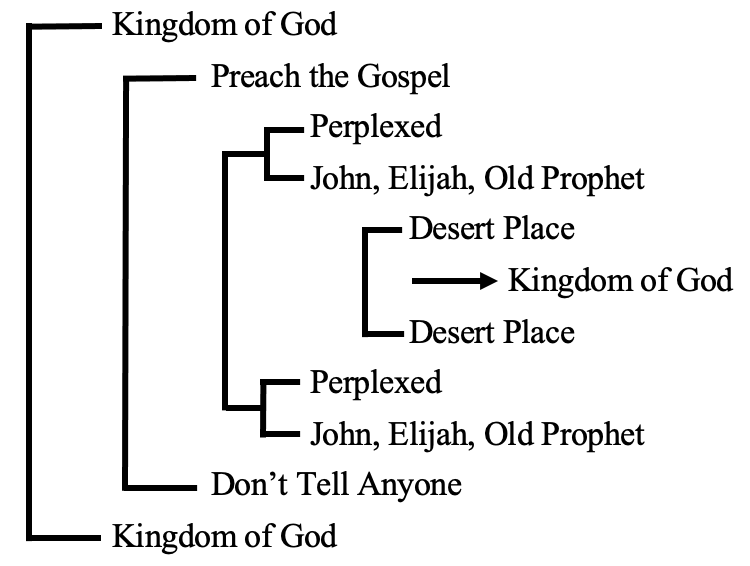
There are many theological truths taught by this structure. I am tempted to talk about a few of them, especially the “Don’t Tell Anyone” frame. That will have to be for another time.
The structure is intentional. God speaks to us on so many levels. Here, God, through structure, is communicating what something means by “how” it is presented structurally. If this thought is foreign to you, consider this idea as a picture frame. Within the frame are the primary items or people you wish to feature or focus upon. God does the same with his Word. Sometimes he will highlight a truth through repetition of words, through poetry, through an acrostic, through chiasms, through themes…you get the idea. In Luke 9, God is communicating truth through structure.
At the center of this structure, we see that the “Kingdom of God” is framed by a “Desert Place.” Jesus had recently given the disciples power and authority to preach the kingdom of God, to cast out devils, and to heal. They had just returned from their ministry travels and shared all that they had accomplished. As a reward for hard work, Jesus takes them for a long walk to a desert place to rest awhile. But when they arrive, five thousand men, not including women and children are waiting for them. I can imagine the disciples saying, “Some vacation this is going to be.”
At first, the disciples, diplomatically, ask Jesus to send them all away. They say: “Send the multitude away, that they may go into the towns and country round about, and lodge, and get food, for we are in a desert place.” Jesus says to them, “You give them to eat!” The disciples respond by saying: “We have no more but five loaves and two fishes; except we should go and buy meat for all this people.” You probably know this story well. Jesus takes what they have and multiplies it and feeds the multitude of people.
What does this mean, or rather, how does this mean? Again, notice the center of the structure:
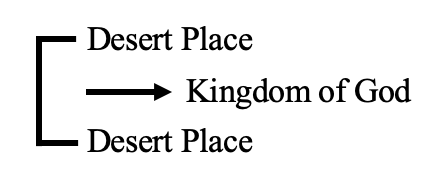
What does this mean by how it is structured? God’s kingdom work is often accomplished in the desert places of life. It is when we have the least amount of resources and are of insufficient means, that God can accomplish the most. All that is needed is to give God what we have. He will do the rest. Too often we miss the opportunities he brings to us because we focus on our lack rather than God’s abundance.
Another interesting observation is that John, Elijah, and an Old Prophet are included in this frame. If you keep reading Luke 9, you will see that Elijah and Moses show up with Jesus on the mountain. This may be a stretch, but I would connect Moses with the old prophet. John, Elijah, and Moses spent a lot of their time in a “desert place.” Each of these three had limited resources but experienced the abundance of God’s provisions.
May this be a reminder for all of us, especially when we think we are insufficient and can’t make a difference. All we need to do is give him what we have, and he will provide the rest.
Sincerely,
Mark Hamby
M.S., M. Div., Th. M., D. Min.
Recommended Reading:
Let Go (by Fenelon)
Jill’s Red Bag Book/Audiobook (Ages 6+)
Dr. Willie and the Fretful Squire Book (Ages 9+)
City Sparrows Book (Ages 12+)