One Day in His Courts
Reflective Reading: Psalm 84
Psalm 84 contains one of my favorite Scriptures:
“For the LORD God is a sun and shield: the LORD will give grace and glory: no good thing will he withhold from them that walk uprightly” (Psalm 84:11).
For the past forty-nine years, I’ve quoted this verse more than any other verse in the Bible. When I meditate upon this verse, I am inspired by God’s promise—“no good thing will he withhold from them that walk uprightly.” This promise excites me and causes me to wonder what God has in store for me! If you look closely, the word “thing” is italicized and is not in the original text. The phrase should read, “No good will he withhold from them that walk uprightly.”
As I studied the meaning of this verse within its context, I began to realize there was a deeper meaning. Join me as we read and experience a truth that I believe will encourage you for the rest of your life:
To the chief Musician upon Gittith. A Psalm for the sons of Korah.
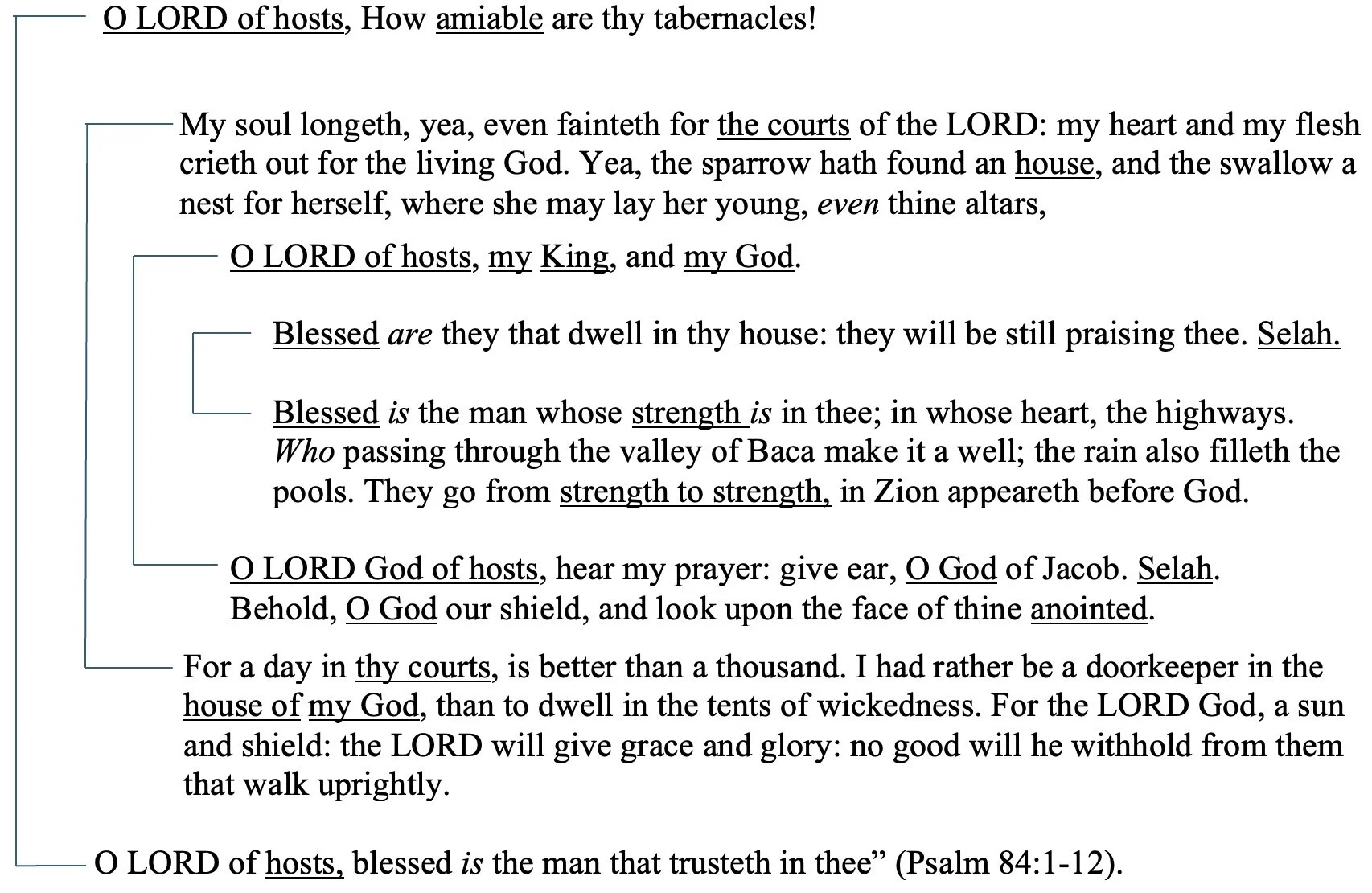
This beautiful psalm is written as a three-part song. It is artistically framed with the words “LORD of hosts” on the outside and the word “Blessed” at the center. I have underlined a few other repeated words that function as additional framing devices to guide the reader into the central meaning of this song.
Let’s start at the beginning where we find the word “amiable” (KJV). This word is also translated as “lovely,” as we have in the ESV. The Hebrew meaning for this word carries the idea of rich intimacy, passion, and intense loveliness and beauty. What is the focus of this loveliness? God’s “tabernacles.” His tabernacles are amiable and lovely. In what sense are God’s tabernacles so lovely, and why are they filled with intimacy, passion, and beauty?
The word “tabernacle” in Hebrew describes a dwelling place or home; a place where you reside near neighbors. Before this study, I never considered the word “tabernacle” as a special place. In fact, the word never intrigued me enough to think of it as anything other than a place of religious activities.
Regarding God’s tabernacles as a place of beauty, intimacy, and loveliness, the next sentence in this psalm adds even more meaning:
“My soul longeth, yea, even fainteth for the courts of the LORD.”
Considering that most, if not all, of the Bible, is in reference to Jesus the Messiah, the King of kings and Savior, this psalm is written from the perspective of the Son of God looking back to his “home,” where he enjoyed intimacy, beauty, and loveliness with His Father. This psalm is pregnant with Messianic words such as “King” and “Anointed.” The word “Anointed” can also be translated—“Messiah.”
Consider that the psalm is written from a sense of homesickness. The Son of God has left His home (tabernacle) in heaven and come to earth where He is a stranger, “nowhere to lay His head.” While on earth, he longs, even faints, for the “courts” of the LORD. The word “courts” is another meaningful word. It refers to a courtyard. Picture a court as a walled area where you are protected from the outside world, a place of beauty and tranquility. If you think of an actual court room where justice is carried out, they are generally majestic in their architecture, with woodcarvings, marble floors, a place of reverence and quiet. The word “courts” in Psalm 84 is also a place of beauty, but even more a place where families gather for protection, fellowship, and enjoyment. The courts would also make up a village where as many as fifty tents would connect circularly. In the midst of these tents, you would find families enjoying the safety and fellowship of their neighbors. Picture tents made of colorful animal skins that give an inviting artistic environment, both near and far.
Next, the psalmist writes that his heart and flesh cry out for the living God. Once again, we are given a sense of longing for the beauty and fellowship Jesus had in the courts of His heavenly home. He continues his thoughts with the idea that even the sparrow and swallow are safely protected there.
We have now reached the center, with the phrase “O LORD of hosts” framing the words “Blessed.”
Blessedare they that dwell in thy house: they will be still praising thee.
Blessedis the man whose strength is in thee; in whose heart, the highways.
The center shows life in heaven, in the house of the LORD, and life on earth, those traveling upon the highways. Though the earthly highway travelers encounter weariness, they find their strength in the LORD as long as they keep their heart focused on their destination—the highway to Zion or the highway to heaven. What a beautiful centerpiece! In the courts and house of heaven, everyone is continuously praising the LORD. On earth, even in the midst of the valley of tears (Baca), believers can be blessed, if their strength is found in the LORD.
Keep in mind that this psalm is Messianic. In verse 8, Jesus is praying to his Father, beseeching that He look upon the face of His Anointed One (Messiah). As He is praying, He remembers what it was like in His heavenly home and says:
“For a day in thy courts, is better than a thousand. I had rather be a doorkeeper in the house ofmy God, than to dwell in the tents of wickedness. For the LORD God, a sun and shield: the LORD will give grace and glory: no good will he withhold from them that walk uprightly.”
Seeing this psalm from the perspective of Jesus looking back at His heavenly home is a game changer for me. No matter what He was going through on earth (valley of weeping), He kept His heavenly memories as His encouragement. In the same way, we as believers are given glimpses of our heavenly home through the blessings that God gives while we sojourn upon the earth. These heavenly glimpses of God’s grace, answers to prayer, loveliness, beauty, and security, serve as reminders that “no good will He withhold from them who walk uprightly.”
We have a heavenly home to look forward to. As we keep our eyes and hearts toward “home,” the more our “soul will long, yea, even faint, for the courts of the LORD.”
Why? One day in His courts is better than a thousand elsewhere.
Sincerely,
Mark Hamby
M.S., M. Div., Th. M., D. Min
Recommended Reading:
Sir Knight of the Splendid Way (book and audio drama)
Sir Malcolm and the Missing Prince (book and audio drama)
The Basket of Flowers (book and audio drama)
The Unexpected Return (book and audio drama)
The Lost Ruby (book)
Shipwrecked but Not Lost (book and audio drama)