Agree Quickly
Reflective Reading: I Kings 11-13
After forty years as king of Israel, the extraordinary power and wealth of Solomon is being threatened for the first time. Trading his wisdom for foolishness, God’s favor has now turned from Solomon as he began to worship the gods of his many wives (I Kings 1:4-11). To crumble his kingdom, God sends three adversaries—Hadad, Rezin, and Jeroboam. A note, worthy to highlight, is that the beginning and end of Solomon’s reign is framed with the word adversary:
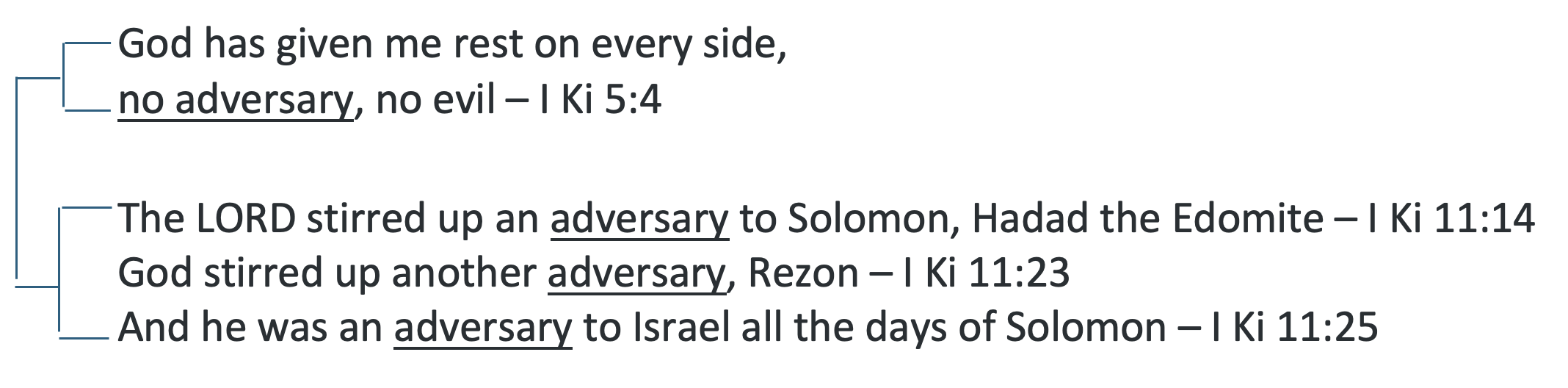
Adversaries are an important theological factor in a believer’s life. They are given to us by God to chasten us and turn us back to him. Jesus said we are to agree quickly with our adversaries (Matthew 5:25). One of the most important lessons I have learned in my Christian journey is just that—agree quickly with my adversary. Whenever I am facing opposition, hostility, or an offense, I must ask myself, what am I to learn, rather than defending myself and fighting for my rights. This action has been a powerful redemptive force in my relationships.
Solomon, however, saw his adversaries as a threat to his authority and power. Rather than learn from what God was trying to teach him, he sought to destroy them, thus losing an opportunity for self-examination and surrender.
The interesting thing about adversaries is that both the adversary and the offended are intended to learn something. If your goal is victory over your adversary, you will incur loss, even if you win. A sense of jubilant vindication is a dangerous response when an adversary receives their just reward. In Proverbs 24 we learn,
“Rejoice not when thine enemy falleth, and let not thine heart be glad when he stumbles.”
It didn’t take long for Solomon’s adversaries to face their own opposition. In I Kings 13, Jeroboam, Solomon’s most powerful adversary, is threatened by his own insecurity. He is fearful and paranoid that if anyone from his new realm goes to worship in Jerusalem, the people will prefer Rehoboam as their king and turn against him, even try to murder him. Jeroboam, like many of the kings of Israel lived in the fear of man rather than the fear of God, focusing more on self-protection than faith (fulness).
As a result of his fear of man, Jeroboam set up various worship sites so that the people didn’t have to travel far. He made worship convenient. He also made life miserable for the godly line of priests and Levites, causing them to leave their homes and flee to the southern kingdom. Without the oversite of this godly line of priests and Levites, Jeroboam was left to himself to worship any way he desired, even taking up the privileged position as priest as well as king. Isn’t that the way some people think? “If I can just get rid of this person and that person, my life would be so much better. Without their annoyances, I would be able to lead, make better decisions, and make life so much better for all, especially myself!” People who think like this will never be able to lead with godly wisdom. Their decisions will always lack the depth of understanding that difficulty (and adversaries) produces endurance, and endurance produces character, and character produces hope, and hope never disappoints, because God’s love is gushed out into their lives through the Holy Spirit given to them (Romans 5:3-5).
As Jeroboam was preparing to sacrifice on the new altar at Bethel, (a responsibility only for the priests), God sent a man of God to stop his presumptuous and rebellious action. Let’s see how Jeroboam responds to God’s anointed adversary:
“And, behold, there came a man of God out of Judah by the Word of the LORD unto Bethel: and Jeroboam stood by the altar to burn incense. And he cried against the altar in the Word of the LORD, and said, O altar, altar, thus saith the LORD; Behold, a child shall be born unto the house of David, Josiah by name; and upon thee shall he offer the priests of the high places that burn incense upon thee, and men's bones shall be burnt upon thee. And he gave a sign the same day, saying, This is the sign which the LORD hath spoken; Behold, the altar shall be rent, and the ashes that are upon it shall be poured out. And it came to pass, when king Jeroboam heard the saying of the man of God, which had cried against the altar in Bethel, that he put forth his hand from the altar, saying, Lay hold on him. And his hand, which he put forth against him, dried up, so that he could not pull it in again to him. The altar also was rent, and the ashes poured out from the altar, according to the sign which the man of God had given by the Word of the LORD. And the king answered and said unto the man of God, Intreat now the face of the LORD thy God, and pray for me, that my hand may be restored me again. And the man of God besought the LORD, and the king's hand was restored him again, and became as it was before. And the king said unto the man of God, Come home with me, and refresh thyself, and I will give thee a reward. And the man of God said unto the king, If thou wilt give me half thine house, I will not go in with thee, neither will I eat bread nor drink water in this place: For so was it charged me by the word of the LORD, saying, Eat no bread, nor drink water, nor turn again by the same way that you came. So he went another way, and returned not by the way that he came to Bethel” (I Kings 13:1-10).
It would seem that Jeroboam has learned an important lesson. You would think that this dramatic moment would leave a lasting impression. But sadly he continued to live in the fear of man. We read:
“After this thing Jeroboam returned not from his evil way, but made again of the lowest of the people priests of the high places: whosoever would, he consecrated him, and he became one of the priests of the high places. And this thing became sin unto the house of Jeroboam, even to cut it off, and to destroy it from off the face of the earth” (I Kings 13:33-34).
Jeroboam surrounded himself with the lowest types of people to avoid opposition. Opposing views and opposition are what makes us stronger, better, wiser. When we face opposition through God’s anointed adversaries, it is for the purpose of turning us back to the LORD and his Word. In verses 1-10, the phrase the “Word of the LORD” appears seven times. This is the main emphasis. Through opposition, God is trying to turn Jeroboam back to following his Word. When we turn to him, he will then “pour out his Spirit, and make his Word known to us” (Proverbs 1:23).
Sincerely,
Mark Hamby
M.S., M. Div., Th. M., D. Min
Recommended Reading:
The Little Woodsman and His Dog Ceasar book or audiobook (Ages 9+)
So Shall We Live (Ages 9+)
Come What May book or audiobook (Ages 12+)