Expect the Unexpected
Reflective Reading: Ecclesiastes 3:1-9
Ecclesiastes 3:1-9 reveals a beautiful form of artistry. If you have heard me talk about this before, I believe you will enjoy the new insights.
As you study the chart below, you will see a symmetrical pattern that reveals not just what these words mean but how they mean. The rhythm and structure of Ecclesiastes 3:1-8 is undeniable. There is an obvious theme of “comparison and contrast.” Today, we’re going to build on this idea of comparison and contrast to highlight an important truth that should come as a surprise!
In the chart below I will list the desirable and undesirable events in couplets. Next to each set of words, I am going to write a “D” for DESIRABLE and a “U” for UNDESIRABLE. For example, in the first set of words, "Born and Die", we see the contrast of what is desirable and what is undesirable—to be born is Desirable; to die is Undesirable.
If you look to the right of the chart below, you will see how these couplets possess a rhythmical musical order:
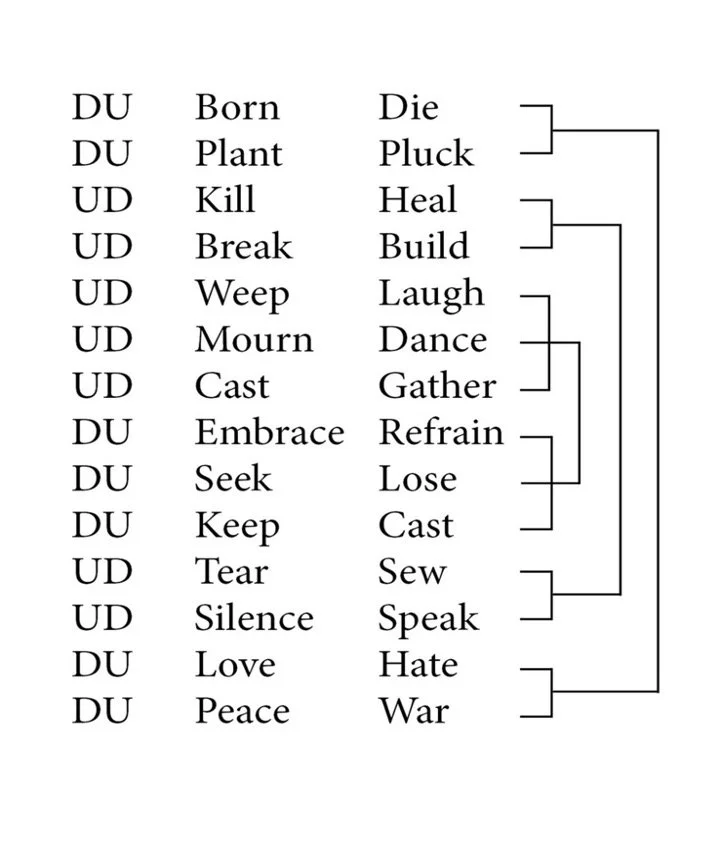
Beautiful, right? The symmetry seems perfect. The beginning and the end match, with a reversal of UD, UD, UD, and DU, DU, DU in the center. Upon commencing this poem/song however, Solomon writes in verse 9, “What profit then has the laborer in all his toil?" Seems like an odd question to ask after this beautiful symmetrical poem.
However, it is a perfect question. Why? Because of my purposeful error! This poem does not really give us perfect symmetry. The last line is an error. It reads PEACE and WAR, but should have been written, WAR and PEACE. The way Solomon wrote this was an intentional disruption! The beauty and structure don't really exist! Rather, this unexpected discordant ending creates an abrupt tension. The enjoyment of this gracefully flowing poem has been replaced with an unexpected cacophony.
It’s like Bach writing a beautiful symphony only to end it with a discordant clanging of cymbals. A Hebrew reader or listener to this poem or song would have expected it to end with a delightful, symmetrical tone. Instead, they are left with dissonance, disruption, and discontinuity.
Solomon writes, “What profit then has the laborer in all his toil?”
Why did Solomon implement this unsettling device? He is making an unforgettable statement to his readers: “Don’t get blindsided when life throws you a curveball. Expect the unexpected—it’s going to happen!”
When Solomon writes, “What profit then…” it is akin to him saying, “Why bother!” “Why bother if I can’t expect life to have a certain amount of certainty?!” If I live a godly life and have three beautiful children and a husband who loves me, then why did I get cancer?! If am living a life of integrity and working diligently, then why did I just get fired?! If I have been a godly husband, then why did my wife file for divorce?! Why was my husband unfaithful?! If I raise my children…fill in the blank. The question is “What does it profit?” Why bother working so hard, and moreover, (get ready for this), why bother trusting God? Why trust God if life is full of these unexpected, undesirable, and often miserable events?
Why? God explains the why in the next verse.
“I have seen the business that God has given to the children of man to be busy with” (Ecclesiastes 3:10, ESV).
“I have seen the travail, which God hath given to the sons of men to be exercised in it” (Ecclesiastes 3:10, KJV).
The word “business,” or “travail,” also translated as “task,” carries the idea of our occupation or work that keeps us busy trying to put bread on the table. The word “exercised” carries the idea of being browbeaten, depressed, afflicted, or humbled. Though a godly life promises a good return and good rewards, there are times when God gives us something unexpected and undesirable. These undesirable events keep us off-balance to humble us so that we will turn to God and trust Him.
The next verse reinforces this interpretation:
“He has made everything beautiful in its/his time” (Ecclesiastes 3:10-11).
What a beautiful, albeit unexpected, conclusion!
Friends, there will be times when we will face unexpected, undesirable events. I’m experiencing one of these as I write. Thankfully, the blessings that I have received in this life far exceed the unexpected and tiresome events. Like my present experience, these unexpected “curveballs” come at a time when everything seems to be going wonderfully well. Then, just like the beautiful symmetrical poem with the dramatic and unexpected ending, God is trying to get our attention. It’s time for more spiritual growth, more maturity. God is preparing us for a new chapter in life. He is preparing us for something far more beautiful and intricate than anything we could have imagined.
God is in control. He is sovereign and He loves us immensely and knows exactly what is best for us. We didn’t have a say when we were born, and neither will we have a say when we will die. God is sovereign and in complete control—beginning to end. Therefore, when unexpected and undesirable trials come our way, let us submit and surrender humbly. When we do, there is a promise that He “will exalt us in due time” (1 Pet 5:6). Do not lose heart; look forward. God is making something beautiful—in His time.
Sincerely,
Mark Hamby
M.S., M. Div., Th. M., D. Min.
Recommended Reading:
Basil: Honesty and Industry (Ages 6+)
My Golden Ship (Ages 7+) Book and Audio Drama
Three Weavers (Ages 7+) Book
Three Weavers Illustrated (All Ages) Book
Seven Days Left (Ages 12+) Book
Jessica’s First Prayer (Ages 8+) Book
Jessica’s Journey (Ages 10+), Audio Drama
Hand on the Bridle (Ages 10+) Book and Audio Drama
Through the Eye of the Needle (Ages 12+)